
Handmade vs Imported Sporrans — What Nobody Tells You Before You Buy
You've spent hundreds — possibly thousands — on your kilt outfit. The tartan is right. The jacket fits perfectly. The sgian dubh is polished. And then, at the last hurdle, you are tempted by a sporran for £35 from a website with a union jack on it and "Made in Scotland" stamped on the back.
We're going to talk about that stamp.
The "Made in Scotland" problem
Walk through any Highland games, scroll through any marketplace, and you'll find sporrans that look the part. Cantle, tassels, fur front, leather body. The label says Scottish. The price feels like a bargain.
But here's what's actually happening: many of these sporrans are manufactured in Pakistan or China, shipped in bulk to the UK, and sold with "Made in Scotland" or "Scottish" branding that refers — at best — to a design that was sketched here, or a business registered here. The manufacturing, the materials, the hands that made it? Nowhere near Scotland.
We know this because we've seen our own designs copied. Sporrans that arrived in our workshop for repair — or that customers brought in to compare before buying from us — that were direct reproductions of pieces our makers had designed. Not inspired by. Copied. Down to the cantle shape, the tassel arrangement, the panel proportions.
There is no copyright protection robust enough to stop this at scale. So instead, we'd rather arm you with the knowledge to spot the difference yourself.
How to tell a handmade Scottish sporran from an import
1. Pick it up. Feel the weight.
A genuine handmade sporran has weight and substance to it. Real leather is dense. Quality metalwork — brass, chrome, antique finish — is solid. The cantle has heft.
An imported sporran made with synthetic materials and a lightweight stamped frame feels immediately different in the hand. It's lighter than it should be. The body doesn't have the same solidity. If you've ever held a quality leather wallet versus a PVC one, you'll know exactly the feeling we mean — and a sporran tells you the same story the moment you pick it up.
Weight is one of the most honest signals a sporran can give you.
2. Read the label — then read between the lines
Many imported sporrans carry labels that say "genuine leather." Under UK consumer law, this means the item contains some real leather — but it doesn't tell you where, how much, or what everything else is made of. It's entirely legal to stamp "genuine leather" on a product where the visible front panel is bonded leather (leather fibres pressed together with polyurethane binders), the back is synthetic, and the internal structure is cardboard or compressed fibre.
Real leather — the kind used in our workshop — is a single piece of full-grain or top-grain hide. It has natural variation in texture and colour. It develops a patina over years of wear. It doesn't peel, crack along factory edges, or delaminate after a few outings.
When you're examining a sporran, look at the edges of the leather panels. Bonded leather and PVC show a uniform, often slightly foamy cross-section when cut. Real leather shows fibrous, natural layers. If the edges are suspiciously clean and uniform, be cautious.
3. Look at how it's held together
Handmade sporrans are stitched. Specifically, they're saddle-stitched or machine-stitched through the full thickness of the leather using nylon thread — the same technique used in quality leatherwork for decades. The stitching is tight, consistent, and structural. It holds the sporran together even if an individual stitch breaks, because each stitch is independent.
Many imported sporrans are glued. The panels are bonded with industrial adhesive and the stitching — if it exists at all — is largely decorative. You can sometimes see this where the glue has been applied unevenly, creating slight ripples or hard edges along seams. More often, you find out when the sporran starts to come apart after a season or two of wear.
Ask yourself: if the stitching fails on a handmade sporran, can it be repaired? Yes — a leatherworker can restitch it. If the glue fails on a bonded sporran, can it be repaired? Not really. Once the bond breaks, the structure is compromised.
4. The metalwork tells a story
The cantle — the metal frame and closure at the top of the sporran — is one of the clearest quality indicators on the piece.
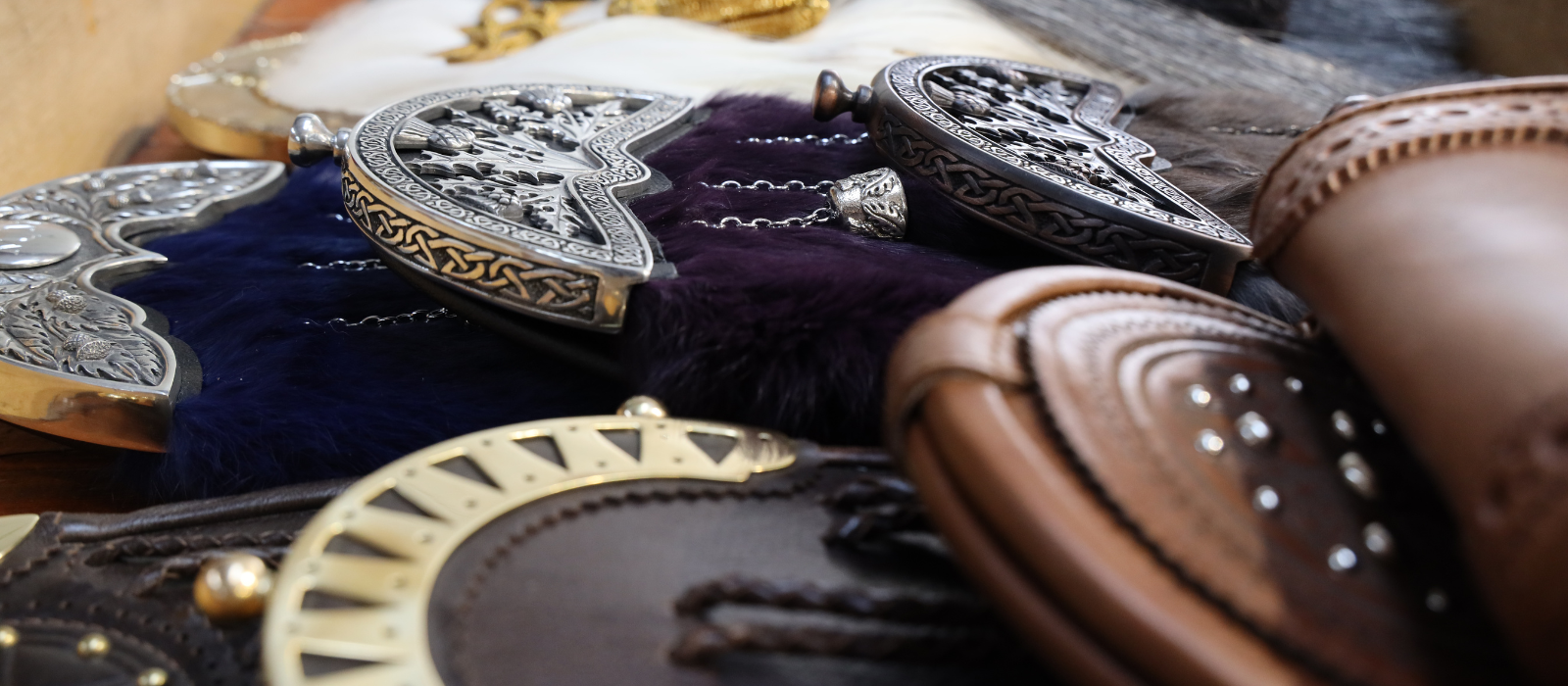
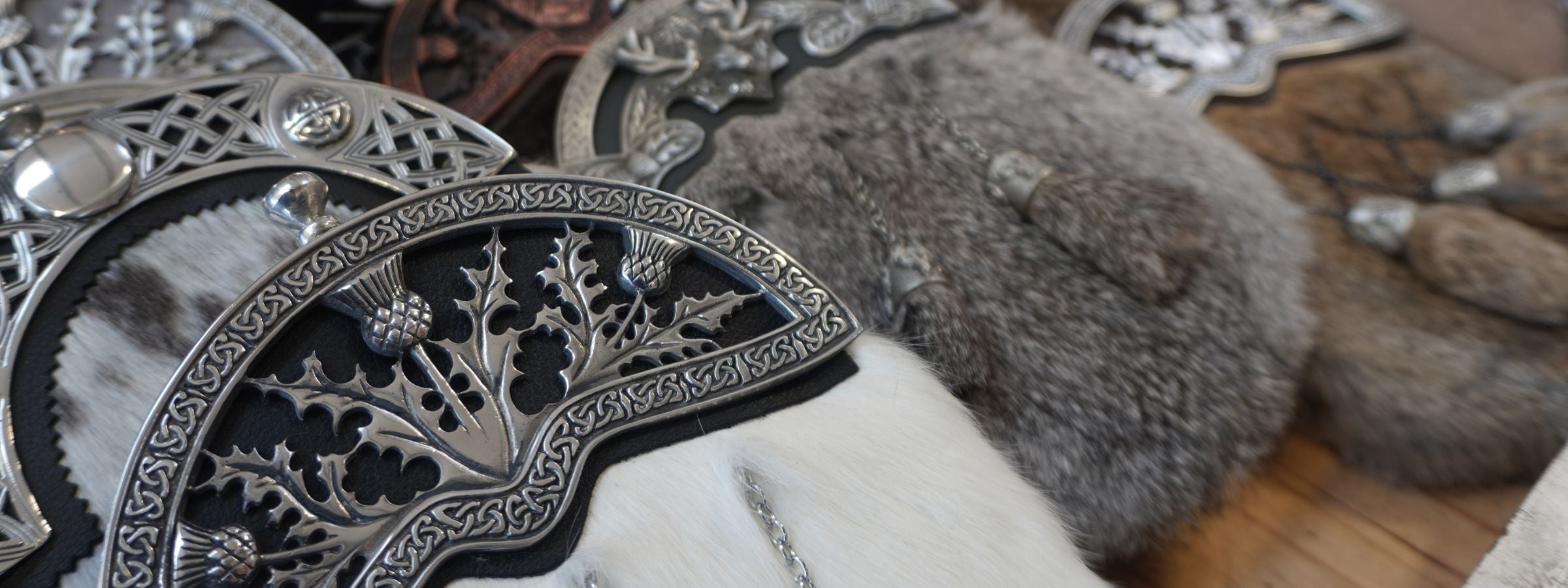
On a quality handmade sporran, the cantle is cast or machined from solid brass, chrome, or pewter. It has weight, crisp detail, and a finish that can be cleaned, polished, and maintained over decades. The engraving is sharp. The hinges operate smoothly. The closure mechanism is satisfying to use.
On many imports, the cantle is stamped from thin sheet metal or cast from a zinc alloy (pot metal). It looks similar in photographs but feels flimsy in person. The finish is painted or electroplated rather than polished — which means it chips, tarnishes unevenly, and can't be restored once it starts to go. You can't polish painted metal back to life. You can absolutely polish a solid brass cantle until it looks brand new fifty years later.
This matters especially if you're buying a sporran as a long-term piece or a gift. Metal that can be maintained is metal that lasts generations. Metal that can only deteriorate will date your sporran visibly within a few years.
5. The fur and hair — licensed and ethical, or not?
A sporran made with real animal fur or horsehair in the UK and EU must comply with strict wildlife trade regulations. The skins must be legally sourced, properly documented, and the seller must hold the appropriate licences under CITES (the Convention on International Trade in Endangered Species).
At our workshop in Perth, every skin and hide we use is ethically sourced and fully licensed. We know where our materials come from. We can account for them. This is not just a legal requirement — it's something we take seriously because these are natural materials that deserve respect, and because our customers deserve to know that what they're wearing is legitimate.
Imported sporrans using animal materials don't always carry the same assurance. The licensing framework in some manufacturing countries is either less stringent or less consistently enforced. If provenance matters to you — and it should — it's worth asking the question before you buy.
Case Study: The Anatomy of an Import
Here is a Swinging Six sporran made overseas, the badger head is black and white which should raise alarm bells, a badger is not naturally this black and white. There are 2 different furs in this sporran the head comprised from what could be a badger and the body from a fox. The brass metal work on the head of the sporran is the wrong shape for this regimental sporran. Finally the positioning of the tassels is not correct, they should sit neatly on the loops on the gold cord.
Badgers are a protected species in the UK, we work alongside licensed taxidermists who have permits to be able to re-purpose these skins professionally with access to the right glass eyes.


6. A cheap sporran cannot be repaired
One of the quiet costs of buying an imported sporran is that when something goes wrong — a tassel lost, a cantle bent, a seam come apart — there's often nothing that can be done. The materials aren't the kind that a craftsperson can work with. The construction methods leave no room for intervention. The sporran becomes disposable.
We repair sporrans in our workshop every week — including some very old, very worn pieces that have been passed down through families for generations. We can do this because they were made properly in the first place. Real leather. Solid metal. Structural stitching. Materials a maker can get their hands into. A handmade sporran is an investment that can be maintained, repaired, and passed on. A cheap import is a single-use accessory with a best-before date.
The craft itself is disappearing
Here's something that doesn't get said enough.
Traditional sporran making is on the Heritage Crafts Association's Red List of Endangered Crafts. That means the number of people in the UK who practice this skill at a professional level has fallen so low that it is considered at risk of disappearing entirely within a generation.
There are very few of us left.
When you buy an imported sporran, you're not just buying a product — you're making a choice about what survives. The people who know how to select the right hide, how to cut and skive leather to the correct thickness for a sporran body, how to set a cantle, how to hand-finish tassels so they fall right — those people are rare. Their knowledge has been passed down over decades and cannot simply be looked up online or recreated from a pattern.
We started Margaret Morrison Ltd in 1991 because we believed this craft was worth keeping. Over thirty years later, we still believe it. But it needs support to survive.
You've already done the hard part
You've invested in your outfit. You've chosen the right tartan. You've thought carefully about the jacket, the hose, the accessories. The whole ensemble is a statement of care and pride.
Don't let the sporran undermine it.
A handmade sporran from a Scottish workshop doesn't just look right — it sits right, moves right, and ages right. It improves with wear the way real leather always does. It tells the same story your kilt does: that what you're wearing was made by someone who knew what they were doing, cared about the result, and put their hands to it.
That's not something a stamped label can give you. But it is something you can feel the moment you pick it up.
At Margaret Morrison Ltd, all our sporrans are handmade in our Perth workshop by our own team of makers. Our leathers and skins are ethically sourced and fully licensed. If you'd like to talk through what makes the right sporran for your outfit or occasion, we're always happy to help — get in touch here.
Browse our full range of handmade Scottish sporrans at morrison-sporrans.co.uk

Written by Kimberley Neil

Leave a comment
This site is protected by hCaptcha and the hCaptcha Privacy Policy and Terms of Service apply.